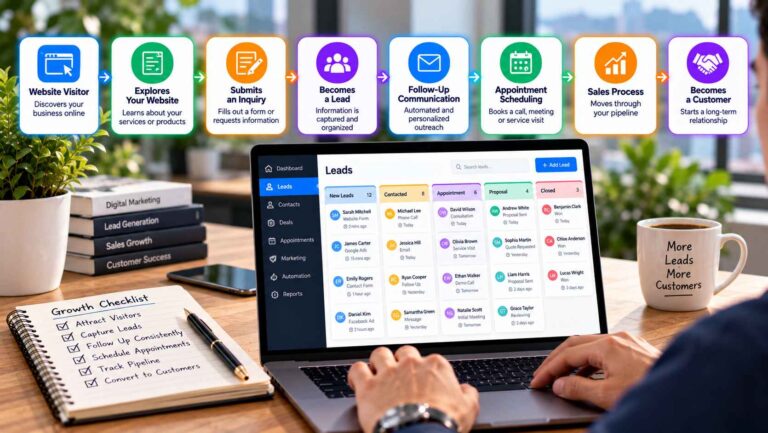
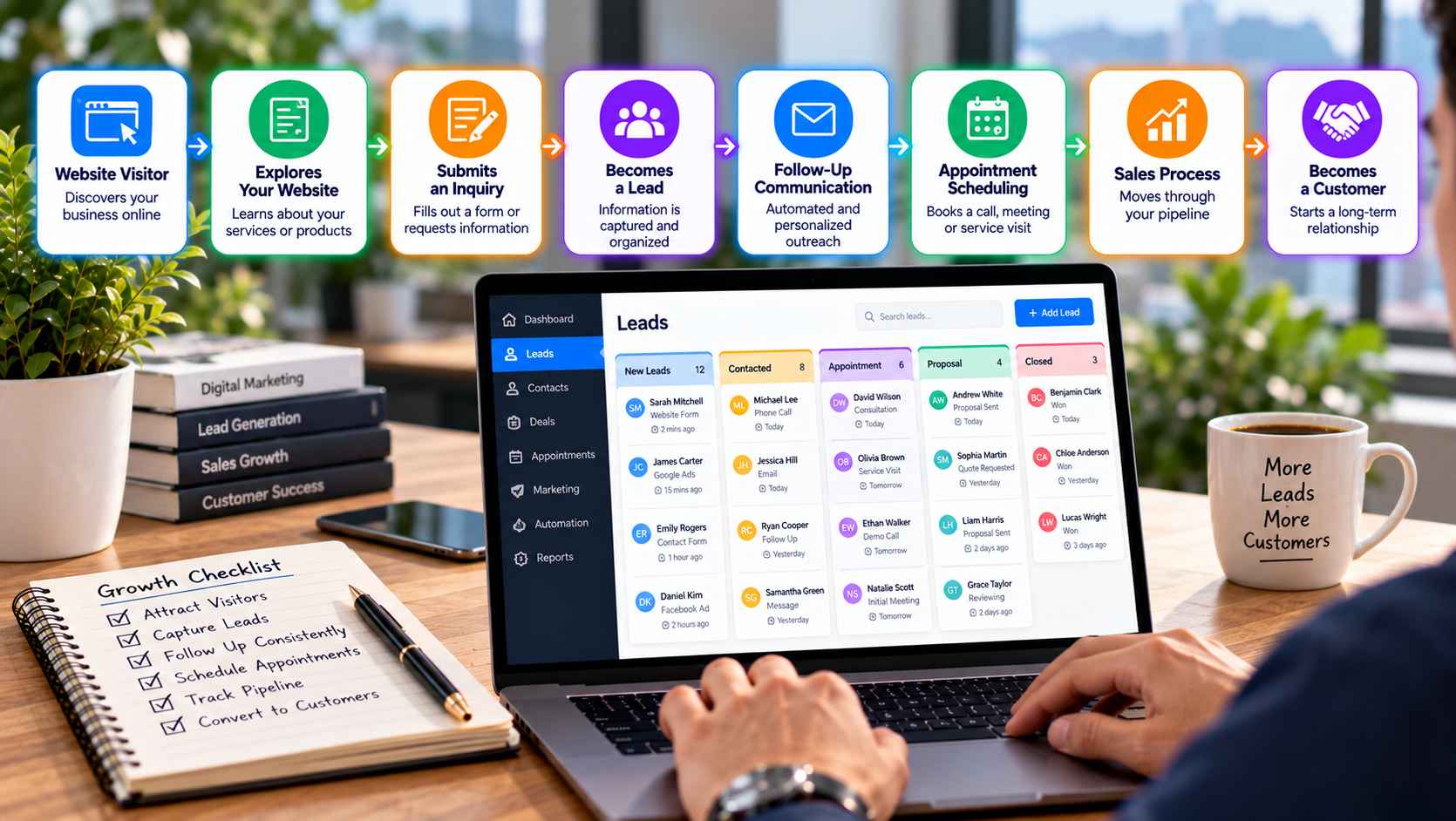
Generating website traffic is an important part of digital growth, but traffic alone does not create customers. Even a visitor who completes a contact form or requests information has only taken an early step in the buying process.
The real opportunity begins after that initial conversion.
Businesses need a process for capturing the lead, understanding whether the inquiry is a good fit, responding promptly, continuing the conversation, and eventually moving the opportunity toward a purchasing decision. Without that process, a business can invest heavily in attracting attention while losing opportunities after people raise their hands.
Digital growth is therefore not just about generating more leads. It is about building a system that can turn relevant interest into meaningful business conversations.
Traffic and Leads Are Not the Finish Line
Search, paid advertising, content marketing, social media, referrals, and other digital channels can all introduce potential customers to a business.
But visitors arrive with different levels of awareness.
Some are simply researching. Others already understand the problem they need to solve and are comparing providers. A smaller group may already know what they want and be ready to request a quote, book an appointment, or make a purchase.
The website should provide an appropriate next step for each situation.
Once someone becomes a lead, the focus changes. The business now has information that can potentially be used to continue the relationship.
For companies looking to connect lead generation with customer management, Client Drive is an example of a platform positioned around CRM and lead-generation activities.
The important principle is that acquisition and conversion should be viewed as connected parts of the same process rather than completely separate marketing functions.
What Happens Immediately After a Lead Is Captured
The first stage after conversion is making sure the lead is properly recorded.
A website form might capture a name, email address, phone number, service request, or other information. A lead generated through advertising may arrive with campaign information attached. Someone contacting the business by phone may provide details that need to be recorded manually.
Without a central process, these inquiries can become scattered across inboxes, spreadsheets, phone notes, and different applications.
A centralized lead record makes it easier to understand who the prospect is, what they are interested in, where they came from, and what action should happen next.
The information collected should also be relevant.
A company does not necessarily need to ask every visitor for extensive details. The goal is to collect enough information to determine how the inquiry should be handled.
Why Response Time and Follow-Up Matter
Generating a lead creates an opportunity, but an opportunity still requires attention.
A prospect may be comparing several providers or simply trying to understand their options. If a business waits too long to respond, the prospect may continue elsewhere.
A structured follow-up process helps prevent this.
Depending on the business, the next step could be a phone call, email, consultation, estimate, product demonstration, or additional information.
Follow-up should also account for the fact that not every prospect is ready to buy immediately.
Someone researching a major service may need several conversations before making a decision. Another person may only need a quick answer before moving forward.
This is where lead nurturing becomes useful. Instead of treating every inquiry as an immediate sale, businesses can maintain appropriate communication while the prospect moves through the decision-making process.
Move Leads Into an Organized Sales Process
Once leads begin arriving consistently, businesses need visibility into their progress.
A sales pipeline can provide that structure.
A simple pipeline might include stages such as:
New Lead → Qualified → Contacted → Appointment → Proposal → Won or Lost
The exact stages will depend on the business.
A contractor may need stages for estimates and site visits. A consultant may focus on discovery calls and proposals. An ecommerce business may have a much shorter path from product interest to purchase.
The purpose is not to create a complicated system. It is to make the current status of each opportunity clear.
A salesperson should be able to see which leads need attention, which prospects are waiting for a response, and which opportunities have progressed further.
Use Automation for Repetitive Follow-Up
Automation can reduce the amount of manual work involved in managing leads.
For example, businesses can use automated processes for inquiry acknowledgments, appointment reminders, follow-up tasks, or other predictable communications.
This does not mean every customer interaction should become automated.
A prospect with a detailed question may need a personal response. Someone considering a high-value service may expect a conversation with a knowledgeable representative.
Automation is most useful when it handles repetitive administrative tasks while allowing employees to focus on interactions that require context and judgment.
Businesses should also make sure automated communication remains relevant. Sending the same message to every lead regardless of their interests or position in the sales process can make the experience feel disconnected.
Connect Lead Generation With Appointment Scheduling
For many businesses, an inquiry is only valuable if it can progress into a meaningful conversation.
Appointment scheduling can help bridge that gap.
A consultant might invite a qualified prospect to book an introductory call. A home service company could arrange an estimate. A software company might schedule a product demonstration.
The scheduling process should match the company’s sales workflow.
Some businesses can allow visitors to book immediately after submitting a form. Others may need to qualify the inquiry first before offering available times.
Connecting the two processes can reduce unnecessary back-and-forth and give the business a clearer view of which leads have progressed from initial interest to an actual conversation.
Measure What Happens Beyond the Initial Conversion
A form submission is useful information, but it is not necessarily the business outcome that matters most.
Businesses should look beyond the initial conversion and examine what happens afterward.
Useful questions include:
Which sources generate qualified inquiries?
How many leads receive follow-up?
How many move into a sales conversation?
Where do opportunities stop progressing?
How many become customers?
Which services or products generate the most relevant opportunities?
These questions help businesses distinguish between activity and meaningful progress.
For example, one marketing channel may generate many form submissions but relatively few qualified opportunities. Another may produce fewer leads but more prospects who progress through the sales pipeline.
Looking at the entire journey provides more useful information than focusing only on the number of leads generated.
Connect Customer Acquisition With Useful Website Experiences
Lead generation also depends on what happens before the form submission.
A visitor needs to understand the business, find relevant information, and feel confident enough to take the next step.
This is particularly important for businesses using SEO and content marketing.
Google’s guidance on creating helpful, reliable, people-first content emphasizes creating useful content for the intended audience rather than producing material primarily to attract search traffic.
That principle applies beyond content itself. A business should consider whether the entire online experience helps visitors accomplish what they came to do.
A useful service page should answer important questions. A landing page should make its purpose clear. A contact form should be straightforward. A call to action should match the visitor’s likely intent.
The better these pieces work together, the more naturally a visitor can progress toward becoming a lead.
Why an Integrated CRM Can Close the Gap
The more channels a business uses to generate demand, the more difficult it can become to manage everything manually.
Leads may arrive from search, advertising, social media, forms, phone calls, referrals, and landing pages. Follow-up may involve email, calls, appointments, and sales activities.
A CRM can bring much of this information into a central workflow.
Instead of asking which spreadsheet contains a prospect’s information or whether someone already followed up, a team can use the customer record and pipeline to understand the current situation.
A lead management system can also be considered when a business wants to connect lead capture with customer information, follow-up, and sales activity in a more organized environment.
The technology itself is not the strategy. The business still needs clear processes for qualification, communication, follow-up, and measurement.
But when those processes are supported by connected tools, it becomes easier to see what happens after the initial lead is generated.
Measure the Journey, Not Just the Lead Count
Businesses often celebrate an increase in traffic or leads because those numbers are easy to see.
But sustainable digital growth requires a broader view.
The real questions begin after the lead arrives: Was the inquiry relevant? Was it contacted? Did the prospect book an appointment? Did the conversation progress? Did the opportunity become a customer?
Answering those questions helps businesses identify where their customer acquisition process is working and where it needs improvement.
Generating more leads can create more opportunities, but it also creates more responsibility to manage those opportunities effectively.
A strong digital acquisition strategy therefore does not end when someone submits a form. It continues through qualification, follow-up, nurturing, appointments, sales conversations, and eventually the customer relationship.
The businesses that understand this complete journey can make better decisions about where to invest their time, technology, and marketing resources.